



SEN Information Report 2025 - 2026
SENDCo - Miss R Taylor
SEND Governor - Mrs C Sarginson
Telephone - 01922 710174
Email - postbox@sunshine.lhmat.com
Type of School - Mainstream Academy
Written by - Miss S Corkindale and Miss R Taylor (September 2025)
Dear parents and carers,
The aim of this information report is to explain how we implement our SEND policy. In other words, we want to show you how special educational needs support works in our school.
If you want to know more about our arrangements for SEND, read our SEND policy.
You can ask a member of staff to make a copy/send you the policy.
Note: If there are any terms we’ve used in this information report that you’re unsure of, you can look them up in the Glossary at the end of the report.
Introduction
Aims of our provision in regards to pupils with special educational needs and/or disability
The aims of our policy and practice in relation to special educational need and disability in this school are:
- To make reasonable adjustments for those with a disability by taking action to increase access to the curriculum, the environment and to printed information for all.
- To ensure that children and young people with SEN engage in the activities of the school alongside pupils who do not have SEN.
- To reduce barriers to progress by embedding the principles in the National Curriculum Inclusion statement https://www.gov.uk/government/collections/national-curriculum
- To use our best endeavours to secure special educational provision for pupils for whom this is required, that is ‘additional to and different from’ that provided within the differentiated curriculum, to better respond to the four broad areas of need:
- Communication and Interaction,
- Cognition and Learning,
- Social, Mental and Emotional health,
- Sensory/Physical.
- To request, monitor and respond to parent/carers’ and pupils’ views in order to evidence high levels of confidence and partnership.
- To ensure a high level of staff expertise to meet pupil need, through well-targeted continuing professional development.
- To support pupils with medical conditions to achieve full inclusion in all school activities by ensuring consultation with health and social care professionals in order to meet the medical needs of pupils.
- To work in cooperative and productive partnership with the Local Authority and other outside agencies, to ensure there is a multi-professional approach to meeting the needs of all vulnerable learners.
1. What are special educational needs (SEN) or a disability?
At our school we use the definition for SEN and for disability from the SEND Code of Practice (2014).
This states:
- Special Educational Needs: A child or young person has special educational needs if he or she has a learning difficulty or disability which calls for special educational provision to be made for him or her.
- A learning difficulty or disability is a significantly greater difficulty in learning than the majority of others of the same age.
- Special educational provision means educational or training provision that is additional to, or different from, that made generally for others of the same age in a mainstream setting in England
- Disability: Many children and young people who have SEN may have a disability under the Equality Act 2010 – that is
‘…a physical or mental impairment which has a long-term and substantial adverse effect on their ability to carry out normal day-to-day activities’.
This definition includes sensory impairments such as those affecting sight or hearing, and long-term health conditions such as asthma, diabetes, epilepsy, and cancer.
2. What types of SEN does the school provide for?
| AREA OF NEED | CONDITION |
| Communication and interaction | Autism spectrum disorder (ASD |
| Speech and language difficulties | |
| Cognition and learning | Specific learning difficulties, including dyslexia, dyspraxia, dyscalculia |
| Moderate learning difficulties | |
| Severe learning difficulties | |
| Social, emotional and mental health | Attention deficit hyperactivity disorder (ADHD) |
| Attention deficit disorder (ADD) | |
| Sensory and/or physical | Hearing impairment |
| Visual impairment | |
| Multi-sensory impairment | |
| Physical impairment |
- Children and young people with SEN have different needs, but the general presumption is that all children with SEN but without an Education, Health and Care Plan (EHCP) are welcome to apply for a place at our school, in line with the school admissions policy. If a place is available, we will undertake to use our best endeavours, in partnership with parents, to make the provision required to meet the SEN of pupils at this school.
- For children with an EHCP, parents have the right to request a particular school and the local authority must comply with that preference and name the school or college in the EHC plan unless:
- it would be unsuitable for the age, ability, aptitude or SEN of the child or young person, or
- the attendance of the child or young person there would be incompatible with the efficient education of others, or the efficient use of resources.
- Before making the decision to name our school in a child’s EHCP, the local authority will send the governing body a copy of the EHCP and then consider their comments very carefully before a final decision on placement is made. In addition, the local authority must also seek the agreement of school where the draft EHCP sets out any provision to be delivered on their premises that have been secured through a direct payment (personal budget).
- Parents of a child with an EHCP also have the right to seek a place at a special school if it they consider that their child’s needs can be better met in specialist provision.
3. Which staff will support my child, and what training have they had?
Our special educational needs co-ordinator, or SENCO
Our SENCO is Miss R Taylor
They have 5 years’ experience in this role. They are a qualified teacher and a member of the middle leadership team.
Are working towards achieving the National Award in Special Educational Needs Co-ordination.
They are allocated 1.5 days a week to manage SEN provision.
Class teachers
All of our teachers receive in-house SEN training, and are supported by the SENCO to meet the needs of pupils who have SEN.
Teaching assistants (TAs)
We have a team of TAs, including a higher-level teaching assistant (HLTA) who are trained to support SEN provision.
External agencies and experts
Sometimes we need extra help to offer our pupils the support they need. Whenever necessary we will work with external support services to meet the needs of our pupils with SEN and to support their families. These include:
- Speech and language therapists
- Educational psychologists
- Occupational therapists
- GPs or paediatricians
- School nurses
- Child and adolescent mental health services (CAMHS)
- Education welfare officers
- Social services and other local authority (LA)-provided support services
- Voluntary sector organisations
In the last three years school staff have received a range of training at three levels; awareness, enhanced and specialist.
Awareness training has been provided to all staff on:
- How to support pupils with Epilepsy
- How to support children with medical needs, including Diabetes
- How to support pupils with Asthma
- How to support pupils with behavioural difficulties
Enhanced training has been delivered on:
- How to support pupils with speech, language and communication difficulties
- Attendance at the termly SENCO Update and at SENCO Forums
- Delivering WELCOMM and Talk Boost programmes to support Communication and Language
Specialist training has been provided on:
- Team Teach - How to support pupils, considering their individual needs. Respond to and de-escalate inappropriate behaviour safely. (Our PPTSM has attended this training).
- ‘Good Autism Practice’ training has been delivered by The Autism Education Trust – North Star Federation to the SENCO and Deputy Headteacher.
- The SENCO has been part of the New SENCO training and the Special Educational Needs Co-ordination award will be completed this year.
- The SENCO has achieved their NPQ in Leading Behaviour and Culture.
- We have a trained ELSA Leader who supports pupils with Emotional needs as identified as part of our graduated approach.
- Makaton for staff within EYFS to support pupils with communication needs
- Administering Medication training to relevant staff.
- Key staff in school have participated in mental health lead training.
- The school has regular visits from SEND specialists who provide advice to staff to support the success and progress of individual pupils.
- An NHS Speech and Language Therapist visits termly to assess and plan support for targeted pupils. These programmes are then delivered by a trained Teaching Assistant.
- The Governor with specific responsibility for SEND has undertaken SEND training.
- We are supported by North Star Inclusion Advisory team regarding the needs of pupils and they work closely with the SENCO during the year.
4. What should I do if I think my child has SEN?
If parents have concerns relating to their child’s learning or inclusion then please initially discuss these with your child’s class teacher. This then may result in a referral to the school SENCO whose name is Rebecca Taylor and whose contact details are Sunshine Academy, Blakenall Lane, Leamore, Walsall, WS3 1HF, telephone number 01922 710174.
- Parents may also contact the SENCO or the Headteacher directly if they feel this is more appropriate.
- All parents will be listened to. Their views and their aspirations for their child will be central to the assessment and provision that is provided by the school.
5. How does our school know if my child needs SEN support?
We know when a pupil needs help if:
- Concerns are raised by parents/carers, external agencies, teachers, the pupil’s previous school or the pupil themselves, regarding concerns relating to inadequate levels of progress or inclusion.
- Screening, such as that completed on entry or as a result of a concern being raised, indicates gap in knowledge and/or skills.
- Whole school tracking of attainment outcomes indicates lack of expected rate of progress.
- Observation of the pupil indicates that they have additional needs
- We ask children to evaluate their learning and to talk about any difficulties they are experiencing
6. How will the school measure my child’s progress?
We continuously monitor and assess children through daily observations, class tasks and when necessary tests or assessments. The assessments we carry out are dependent upon the ability of the child and in a way we feel is suitable for the individual child according to their needs.
We will follow the ‘graduated approach’ to meeting your child’s SEN needs.
The graduated approach is a 4-part cycle of assess, plan, do, review.
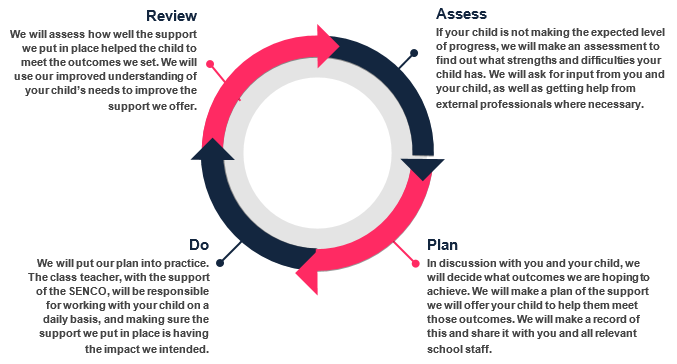
As a part of the planning stage of the graduated approach, we will set outcomes that we want to see your child achieve.
Whenever we run an intervention with your child, we will assess them before the intervention begins. This is known as a ‘baseline assessment’. We do this so we can see how much impact the intervention has on your child’s progress.
We will track your child’s progress towards the outcomes we set over time and improve our offer as we learn what your child responds to best.
This process will be continual. If the review shows a pupil has made progress, they may no longer need the additional provision made through SEN support. For others, the cycle will continue and the school's targets, strategies and provisions will be revisited and refined.
7. How will the school support a child with SEND?
All pupils will be provided with high quality teaching that is differentiated to meet the needs of all learners. The quality of classroom teaching provided to pupils with SEND is monitored through a number of processes that include:
- Classroom observation by the senior leadership team, the SENCO, external verifiers.
- Ongoing assessment of progress made by pupils with SEND.
- Work sampling and scrutiny of planning to ensure effective matching of work to pupil need.
- Teacher meetings with the SENCO to provide advice and guidance on meeting the needs of pupils with SEND.
- Pupil and parent feedback on the quality and effectiveness of interventions provided.
- Attendance and behaviour records.
- Pupils with a disability will be provided with reasonable adjustments (such as auxiliary aids and services) to overcome any disadvantage experienced in schools and increase their access to the taught curriculum.
- Pupils who are looked after by the authority are entitled to receive Pupil Premium funding and have additional support to achieve their PEP targets. This support will include provision to meet any additional needs they may have with regard to SEN.
- All pupils have individual EYFS/National Curriculum targets set in line with National outcomes to ensure ambition. Parents are informed of these via the reporting system and also at events such as Parents’ Evenings.
- Pupils’ attainment is tracked using the whole school tracking system ‘Insight’ and those failing to make expected levels of progress are identified very quickly. These pupils are then discussed in half termly progress meetings that are undertaken between the class/subject teacher and a member of the Senior Leadership team and if appropriate, the pupil themselves.
- Additional action to increase the rate of progress will be then identified and recorded that will include a review of the impact of the differentiated teaching being provided to the child, and if required, provision to the teacher of additional strategies to further support the success of the pupil.
- Where it is decided during this early discussion that special educational provision is required to support increased rates, parents will be informed that our School considers their child may require SEN support and their partnership sought in order to improve children’s attainment.
- Action relating to SEN support will follow an assess, plan, do and review model:
- Assess: Data on the pupil held by the school will be collated by the class teacher/Assistant Head and Phase Leader for Key stage 1/Deputy Head teacher and Phase Leader for EYFS/SENCO in order to make an accurate assessment of the pupil’s needs. Parents will always be invited to an early discussion to support the identification of action to improve outcomes.
- Plan: If review of the action taken indicates that “additional to and different from” support will be required, then the views of all involved including the parents and the pupil will be obtained and appropriate evidence-based interventions identified, recorded and implemented by the class teacher with advice from the SENCO.
- Do: SEN support will be recorded on a plan that will identify a clear set of expected outcomes, which will include stretching and relevant academic and developmental targets that take into account parents’ aspirations for their child. Parents and the pupil will also be consulted on the action they can take to support attainment of the desired outcomes. This will be recorded and a date made for reviewing attainment.
- Review: Progress towards these outcomes will be tracked and reviewed termly with the parents and the pupil. If pupil’s achieve their targets sooner than at the termly review, new targets will be set in the meantime.
If progress rates are judged to be inadequate despite the delivery of high quality interventions, advice will always be sought from external agencies regarding strategies to best meet the specific needs of a pupil. This will only be undertaken after parent permission has been obtained and may include referral to:
- Walsall Advisory Support Team Local Offer
- Walsall Education Psychology Service Local Offer
- Rushall Inclusion and Advisory Team https://www.northstarfederation.org.uk
- Walsall Speech and Language Therapy - https://www.walsallhealthcare.nhs.uk/our-services/speech-and-language-therapy/ (Currently under review) Tel: 01922 605400
- Walsall Children’s Disability Team (Social Services) Tel: 01922 654634
- Walsall School Nursing Service https://www.walsallhealthcare.nhs.uk/our-services/school-nursing/parents-and-carers/ Tel: 01922 423349
- Child & Adolescent Mental Health Service (CAMHS) Tel: 01922 607400
- Walsall SEND Information, Advice and Support Service or SENDIASS Tel: 0808 802 6666
- Autism West Midlands http://www.autismwestmidlands.org.uk
- Positively Special
N.B. For a very small percentage of pupils, whose needs are significant and complex and the SEN Support required to meet their needs cannot reasonably be provided from within the school’s own resources, a request will be made to the local authority to conduct an assessment of education, health and care needs. This may result in an Education, Health and Care (EHC) plan being provided. Please see Walsall Local Offer information https://send.walsall.gov.uk/
8. How will the school adapt its teaching for my child?
Your child’s teacher is responsible and accountable for the progress and development of all the pupils in their class.
High-quality teaching is our first step in responding to your child’s needs. We will make sure that your child has access to a broad and balanced curriculum in every year they are at our school.
We will differentiate (or adapt) how we teach to suit the way the pupil works best. There is no '1 size fits all’ approach to adapting the curriculum, we work on a case-by case basis to make sure the adaptations we make are meaningful to your child.
These adaptations include:
- Differentiating our curriculum to make sure all pupils are able to access it, for example, by grouping, 1-to-1 work, adapting the teaching style or content of the lesson, etc.
- Differentiating our teaching, for example, giving longer processing times, pre-teaching of key vocabulary, reading instructions aloud, etc.
- Adapting our resources and staffing
- Using recommended aids, such as laptops, coloured overlays, visual timetables, larger font, etc.
- Teaching assistants will support pupils on a 1-to-1 or small group basis dependent upon the task
| AREA OF NEED | CONDITION | HOW WE SUPPORT THESE PUPILS |
|
Communication and interaction |
Autism spectrum disorder (ASD) | Visual timetables |
| Speech and language difficulties | Speech and Language therapy | |
| Cognition and learning | Specific learning difficulties, including dyslexia, dyspraxia and dyscalculia | Writing slope |
| Moderate learning difficulties | ||
| Severe learning difficulties | ||
| Social, emotional and mental health | ADHD, ADD | Quiet workstation |
| Adverse childhood experiences and/or mental health issues | ELSA Nurture provision |
|
| Sensory and/or physical | Hearing impairment | Sound system |
| Visual Impairment | Limiting classroom displays | |
| Multi-sensory impairment | ||
| Physical impairment |
These interventions are part of our contribution to Walsall’s local offer.
Teachers plan using pupils’ achievement levels, differentiating tasks (including enabling activities) to ensure progress for every pupil in the classroom.
- When a pupil has been identified as having special educational needs, the curriculum and the learning environment will be further adapted by the class teacher to reduce barriers to learning and enable them to access the curriculum more easily.
- These adaptations may include strategies suggested by the Special Educational Needs Coordinator (SENCO) and/or external specialists.
- In addition if it is considered appropriate, pupils may be provided with specialised equipment or resources such as ICT and/or additional adult help. All actions taken by the class teacher will be recorded and shared with parents.
- We consider how children learn best and consult with them to involve them in their education.
- Children who require it will be supported with a personalised curriculum suited to their needs as detailed in their EHCP.
9. How will parents know how their child is doing?
Attainments towards the identified outcomes will be shared with parents termly through feedback regarding SEN support reviews but also through the school reporting system and Parents’ Consultation Evenings.
- Parents may also find the home-school diary a useful tool to use to communicate with school staff on a more regular basis.
- Families of pupils with SEND will be offered at least one additional meeting with the SENCO per term which is optional but advisable to attend.
- IEP and support plan reviews will be held once a term and shared with parents alongside a copy which will be sent home.
- Parents are encouraged to arrange an appointment to discuss their child’s progress with the class teacher, the SENCO, or a member of the senior leadership team, at any time when they feel concerned or have information they feel they would like to share that could impact on their child’s success. Please contact the school office who will arrange this appointment for you. The contact number is 01922 710174.
10. How will parents be helped to support their child’s learning?
- The class teacher or SENCO may suggest additional ways of supporting your child’s learning.
- The school organises a number of parent workshops during the year. These are advertised in the school newsletter and on our website and aim to provide useful opportunities for parents to learn more about how to support their child’s learning.
- An opportunity to meet with our SEND advisory team and School Nursing team is available at key points during the year.
- If you have ideas on support that you would like to have access to in order to further support your child’s learning, please contact the SENCO who will locate information and guidance for you in this area.
11. What support will there be for children’s overall well-being?
The school offers a wide variety of pastoral support for pupils. This includes:
- An evaluated Personal Development (PSHE – KS1/PSED - EYFS) curriculum that aims to provide pupils with the knowledge, understanding and skills they need to enhance their emotional and social knowledge and well-being. Please visit our website to see the topics that are included within this area of the curriculum.
- Pupil and Parent voice mechanisms are in place and are monitored for effectiveness by the Governor for responsibility for this area.
- Parents and pupils are asked to complete questionnaires to evaluate their feelings about school.
- Small group evidence-led interventions to support pupil’s well-being are delivered to targeted pupils and groups. These are identified on the provision maps located in class rooms and aim to support improved interaction skills, emotional resilience and well-being.
- Pupils with SEND are supported to engage in additional personal development activities which enable us to listen to their views. As a school, we involve them in making decisions about their education and ensure measures are in place to prevent bullying. Pupils respond to a survey to help us decide how to improve and best meet their needs.
- Pupils who find outside class times difficult can be supported to access alternative opportunities within the school and action is taken to develop their social interaction skills.
12. Pupils with medical needs (Statutory duty under the Children and Families Act)
- Pupils with medical needs will be provided with a detailed Individual Health and Care Plan, compiled in partnership with the School Nurses/Paediatric Nurses (when advice is needed) and parents and if appropriate, the pupil themselves.
- Staff who volunteer to administer and supervise medications, will complete formal training and be verified by the School/Paediatric Nurses as being competent, when necessary.
- All medicine administration procedures adhere to the LA policy and Department of Education (DfE) guidelines included within Supporting pupils at school with medical conditions (DfE) 2015 and identified in the School Medicine Administration Policy.
13. What specialist services are available at the school?
The school has access to a range of specialist support services that are identified in section 7.
14. How will my child be included in activities outside the classroom including school trips?
- Risk assessments are carried out and procedures are put in place to enable all children to participate in all school activities as far as is reasonable.
- Alternative arrangements will be made to ensure that children are able to participate in out of school activities that are developmentally appropriate.
- The school ensures it has sufficient staff expertise to ensure that no child with SEND is excluded from any school provided activity.
15. How accessible is the school environment?
The following adaptations have been made to the school environment:
- All steps are edged with yellow to ensure they are easier for those with visual impairments to negotiate.
- A low extended Ramp into the main school entrance, ensures the site is accessible to all.
- One toilet has been adapted to ensure accessibility for visitors with a disability. There is also an adapted toilet with a handrail for children.
- A First Aid room is available in order to create a safe place for children with medical conditions who need to have medication administered.
Our Accessibility Plan (statutory requirement) describes the actions the school has taken to increase access to the environment and the curriculum. Printed information is available via the school office.
16. How will the school prepare/support my child when joining or transferring to a new school?
A number of strategies are in place to enable effective pupils’ transition.
These include -
On entry:
- A planned introduction programme is delivered in the Summer term to support transfer for pupils starting school in September.
- Parent/carers are invited to a meeting at the school and are provided with a range of information to support them in enabling their child to settle into the school routine.
- In June each year, Reception staff usually visit Local Nursery schools to meet children who do not attend Sunshine Nursery and whom will be starting Reception in September.
- On entry to Nursery – Nursery staff will usually offer home visits for September. The purpose of the visits is to get to know children in their home setting and give parents an additional opportunity to share their valuable knowledge of their child.
- The SENCO contacts all new parents of pupils who are known to have SEND to allow concerns to be raised and solutions to any perceived challenges to be located prior to entry.
- If pupils are transferring from another setting, the previous school records will be requested immediately and a meeting set up/ contact made with parents to identify and reduce any concerns.
Transition to the next school, preparation for adulthood and independent living
Primary:
- The transition programme in place for pupils provides a number of opportunities for pupils and parents to meet staff in the new school. These opportunities are further enhanced for pupils with SEND.
- The annual review in Y2 for pupils with a statement of educational need or an EHCP begins the process where parents are supported to make decisions regarding KS2 choice.
- Parents will be encouraged to consider options for the next phase of education and the school will involve outside agencies, as appropriate, to ensure information provided is comprehensive but accessible.
- Accompanied visits to other providers may be arranged as appropriate.
- For pupils transferring to local schools, the SENCOs of both schools will meet to discuss the needs of pupils with SEN in order to ensure a smooth transition.
- The records of pupils who leave the school mid-phase will be transferred within five working days (as far as is possible) of the parents notifying their child has been enrolled at another school.
17. How are the school’s resources allocated and matched to children’s special educational needs?
The school receives funding to respond to the needs of pupils with SEND from a number of sources that includes:
- A proportion of the funds allocated per pupil to the school to provide for their education called the Age Weighted Pupil Unit.
- The Notional SEN budget. This is a fund devolved to schools to support them to meet the needs of pupils with SEND.
- For those pupils with the most complex needs, the school may be allocated additional educational needs funding from the Local Authorities High Needs SEN Funding allocation.
This funding is then used to provide the equipment and facilities to support pupils with special educational needs and disabilities through support that might include:
- Targeted differentiation to increase access to text (desk copies of information, work buddy, accessible text, IT e.g. read aloud software, different recording strategies, additional time etc.)
- In class, adult or peer support aimed at increasing skills in a specific area of weakness (learning behaviours, organisation, etc.)
- Out of class support (relationship building, social, emotional skill development)
- Small group tuition to enable catch up (subject or targeted at additional need)
- Specific support, advice and guidance is provided to parents and families to improve pupil’s readiness for learning (relating to pupil’s difficulties in attendance, behaviour, physiological and emotional needs etc.)
- Provision of specialist resources or equipment (use of ICT, sloping board, electronic versions of text etc.)
- Partnership working with other settings (Parent Pupil Teacher Support Manager liaises with the local Junior school’s Learning mentor, shared expertise, support from local special schools regarding transition/holiday provision)
- Access to targeted enrichment that will consist of drumming therapy sessions, arts and crafts and brick by brick therapy amongst others.
- Access to the school nurse and wider health professional support (responding to mental and physical health issues, speech, language and communication needs, motor control and mobility needs)
- Access to support from in-school sources e.g. Parent Pupil Teacher Support Manager (peer or adult) or from Speech and Language services
- Implementation of strategies from support agencies e.g. Educational Welfare Support
In addition:
- The Pupil Premium funding provides additional funding for pupils who are claiming Free School Meals, who are in the care of the local authority or whose parents are in the Armed Services. The deployment of this funding is published on the school website.
- If parents wish to discuss the options available for their child, they are welcome to make an appointment to see the class teacher, SENCO or a member of the Senior Leadership Team.
18. How is the decision made about how much support each child will receive?
- For pupils with SEND but without a statement of educational need/EHCP, the decision regarding the support provided will be taken at joint meetings with the SENCO, class teacher and parent who will follow guidance provided by the Governing Body regarding SEN Funding deployment.
- For pupils with a statement of educational need/EHCP, this decision will be reached in agreement with parents when the EHCP is being produced or at an annual review.
- For pupils who are looked after by the Local Authority and have SEN, their needs will be discussed at their termly/6 monthly PEP meeting.
19. How will I be involved in discussions about and planning for my child’s education?
This will be through:
- discussions with the class teacher, SENCO or senior leadership team member,
- during parents evenings,
- meetings with support and external agencies.
All parents/carers are invited to request informal meetings to raise issues of concern and to ensure the school provision is responsive to pupil and family needs.
20. Who can I contact for further information or if I have any concerns?
If you wish to discuss your child’s special educational needs or are unhappy about any issues regarding the school’s response to meeting these needs please contact the following:
- Your child’s class teacher,
- The SENCO,
- The Head teacher,
- For complaints, please contact the School Governor with responsibility for SEND. Her name is Mrs. Claire Sarginson. She can be contacted via the School Office.
21. Support services for parents of pupils with SEN include:
- Walsall SEND Information, Advice and Support Service or SENDIASS, previously known as Parent Partnership Services (PPS) offer independent advice and support to parents and carers of all children and young people with SEND. The nearest SENDIASS can be located via Walsall SENDIASS - Family Action
- SENDIASS will also provide information on how to access an Independent Supporter for those parents whose children are being assessed for an EHCP. Independent Supporters aim to provide guidance to parents regarding the EHCP process.
- For parents who are unhappy with the Local Authority or school responses to their child’s SEND, parents may seek mediation from the regional mediation services.
- Parents and Carers can also appeal to the Government’s SEND tribunal if you disagree with the Local Authorities decisions about your child’s special educational needs. You can also appeal to the tribunal if the school or council has discriminated against your disabled child.
- Walsall Children and young people’s service directory Children and young people | Walsall Council
22. What support is in place for looked-after and previously looked-after children with SEN?
Miss S Corkindale (Headteacher) is the designated teacher for looked-after children and previously looked-after children here.
Miss Corkindale will work with Miss Taylor, our SENCO, to make sure that all teachers understand how a looked-after or previously looked-after pupil’s circumstances and their SEN might interact, and what the implications are for teaching and learning.
Children who are looked-after or previously looked-after will be supported much in the same way as any other child who has SEN. However, looked-after pupils will also have a personal education plan (PEP). We will make sure that the PEP and any SEN support plans or EHC plans are consistent and complement one another.
23. Information on where the Local Authority’s Local Offer can be found
The Walsall Local Authority ‘Local Offer’ and also the information it provides to parents and carers on mediation and conflict resolution services can be found here Welcome to Walsall's SEND Local Offer | Send
--------------------------------------------------------------------------------------------------------------------------------------------------------------
References
The SEND Code of Practice (Jan 2015). The Code of Practice provides statutory guidance on duties, policies and procedures relating to Part 3 of the Children and Families Act 2014 and associated regulations https://www.gov.uk/government/uploads/system/uploads/attachment_data/file/342440/SEND_Code_of_Practice_approved_by_Parliament_29.07.14.pdf
Supporting pupils at school with medical conditions Dec 2015.
SE7 Local Offer: Framework and Guidance. https://se7pathfinder.files.wordpress.com/2013/12/se7-local-offer-framework-final.pdf
Glossary (A glossary of SEND terms is included in the appendices of the SEND Code of Practice p267 to p275) https://assets.publishing.service.gov.uk/media/5a7dcb85ed915d2ac884d995/SEND_Code_of_Practice_January_2015.pdf